A jointed pilot and a longer ejection
The pilot now has a head, torso, arms and legs, and an ejection runs as a sequence from seat rocket to parachute to landing.
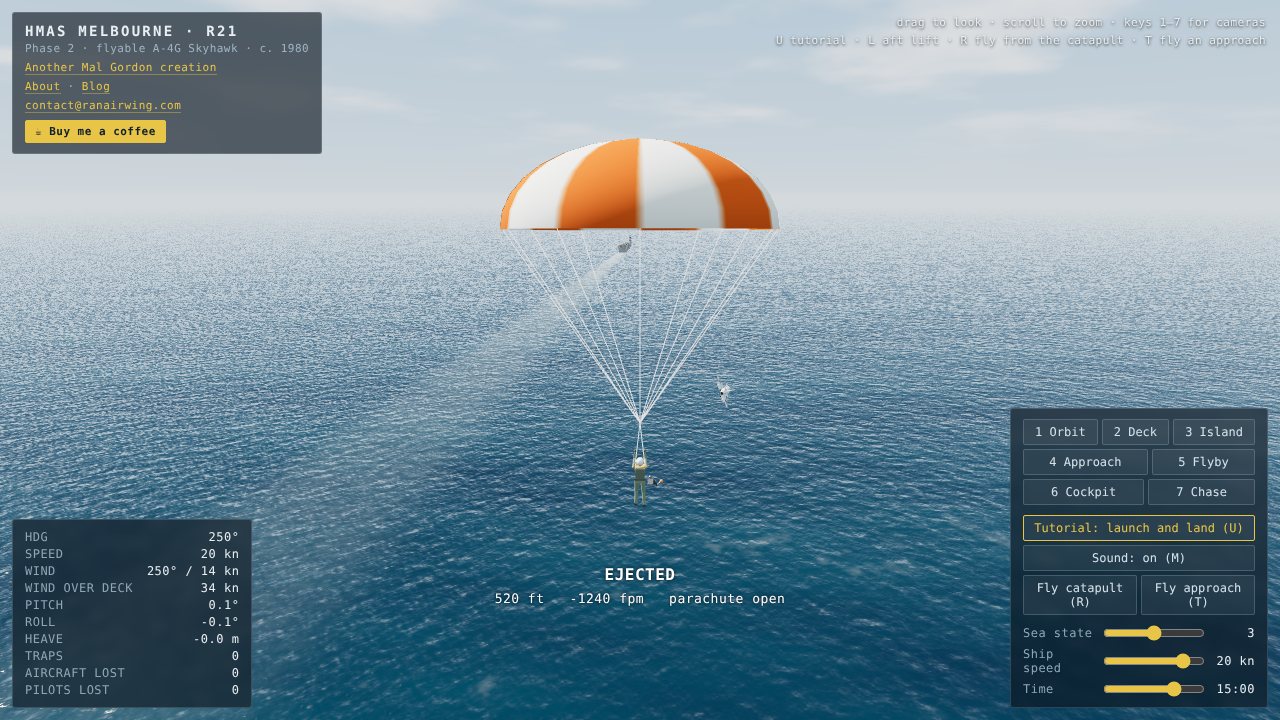
The pilot used to be three boxes and a helmet. Now there is a body, and the ejection is a sequence you can watch.
The pilot
The pilot has a helmet with a visor and oxygen mask, a torso with harness straps and a parachute pack, a life preserver around the neck, and two arms and two legs, each with its joints. Gloves and boots are modelled.
In the cockpit of the A-4G or the S-2 Tracker the pilot sits in a rocket seat. The right hand follows the stick and the left hand follows the throttle, and the head sags a little under g. You see this from the outside cameras, for example Chase (7). The Cockpit camera (6) looks out from the pilot's eyes, so the body is not drawn there.
The ejection
Press X twice, as before. What happens next, with times from the moment of the second press:
- Canopy. The canopy goes first. The pilot's hands come up to the face and the legs are drawn in.
- Seat rocket, 0 to 0.45 s. The seat fires along its rails and climbs away from the aircraft.
- Windblast. Once the hands let go, the arms and legs flail. The faster the air moves past, the harder they are thrown about, up to about 65 m/s (roughly 125 kn).
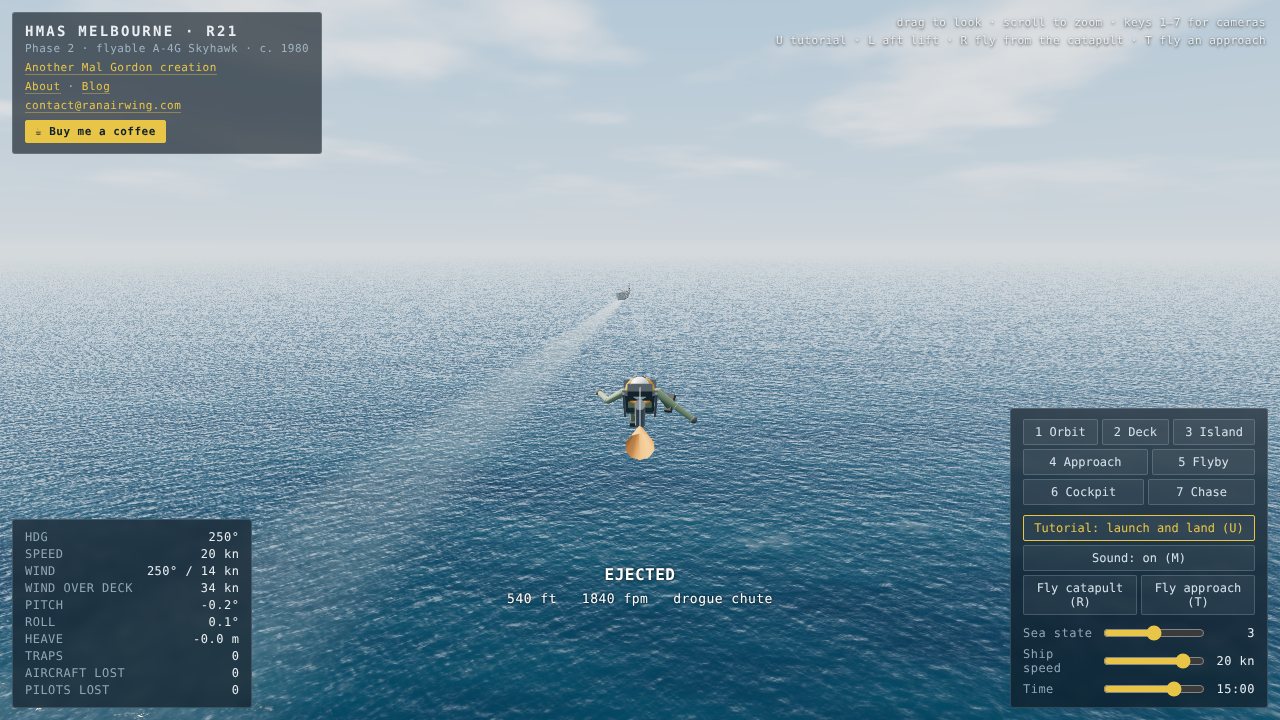
- Drogue, from 0.45 s. After the rocket burns out the seat pitches backwards. A small drogue parachute streams downwind of the seat and damps the tumble.
- Separation, at 1.3 s. The seat falls away on its drogue and the pilot is pushed clear.
- Main parachute, from 1.6 s. The canopy opens over about a second and a half. The pilot swings upright with both hands on the risers and the legs hanging, and sways a little on the way down at about 6.5 m/s.
The readout under the camera follows the stages: seat rocket, drogue chute, seat separated, parachute opening, parachute open.
Landing
The rules are the same as before. A pilot who hits the deck or the sea before the parachute is almost fully open, while falling fast, is killed. Otherwise:
- In the water. The life preserver inflates and the pilot floats head up. The message says the rescue helicopter picks the pilot up.
- On the flight deck. The pilot lands and sits up.
- Too low. The pilot lies still and the life preserver stays flat.
What is still approximate
- The seat is a generic rocket seat. It is not a model of the seat fitted to either aircraft, and the timings are tuned to look right, not taken from seat data.
- The limbs are animated, not simulated. The flailing is a set of overlapping oscillations scaled by airspeed, not a physics model of a body in the airstream.
- The drogue steadies the tumble but adds no drag, so the seat and pilot fall at the same rate as before.
- The pilot's hands in the cockpit move with the controls but are not placed on a modelled stick or throttle.
See crashes, ejecting and the counters for what the counters do after an ejection.